
Reptiles
Reeves’s turtle
Reeves’s turtle
Classification and scientific name: Mauremys reevesii
Sources checked:
A pond turtle that nests on land
Follow the three ridges on the shell and the lines behind the eye. The journey from feeding in water to nesting on a grassy bank shows how much of the shoreline this turtle uses.
Origins and distribution
Rivers, ponds and reservoirs in Korea, with adjoining channels and grassland
- Shell ridges
- Freshwater turtle
- Nesting ground
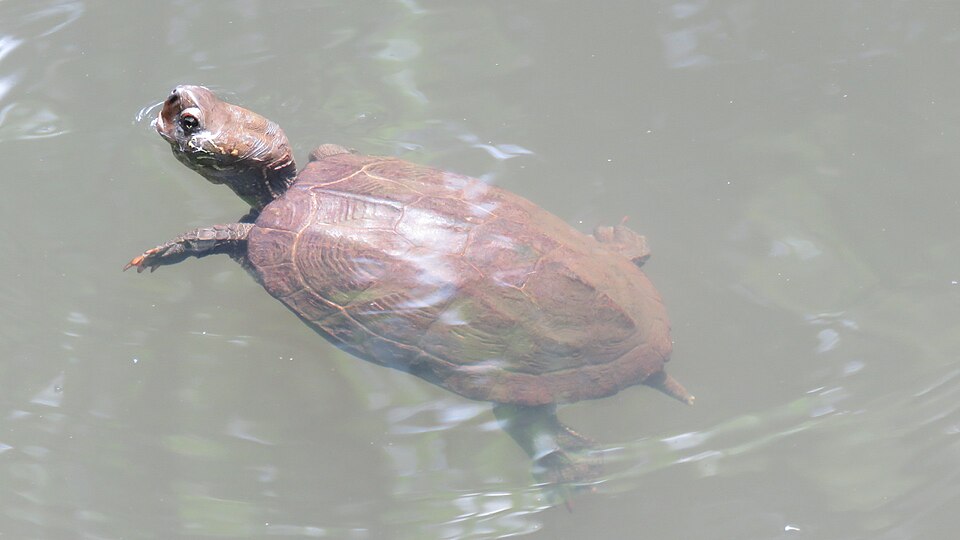
Reference photograph
A brown Reeves’s turtle swimming with its head raised at the surface, seen from above with its shell and one front foot visible. Shown at a reduced size supplied by Wikimedia.
Source: Piropiro77 · Original material: Mauremys reevesii - Institute for Nature Study, Tokyo.JPG · CC BY-SA 4.0
1. Three ridges along the shell
Three raised lines run down the upper shell from the neck toward the tail. One follows the middle of the back, with one on either side. Look for long ridges in the surface of the brown shell as well as the seams between the hard plates that cover it. They are two different sets of lines.
2. When the head markings fade
Pale streaks extend from behind the eye toward the nape. In some mature males the eyes and shell gradually darken, and the markings on the sides of the head can all but disappear. If they are hard to see in a field photograph, look at the shell shape too and leave open any feature the camera angle hides.
3. Food on the pond floor
In ponds and reservoirs the turtle eats both threadlike green algae and snails that crawl across the bottom. Insects, crustaceans and dead fish are also on its menu. A turtle seen feeding on a snail is sampling just one part of this omnivore’s diet. Korea’s National Institute of Ecology describes turtles moving between reservoirs, channels, rice paddies and grassland. Tracing the waterways from an observation point puts the feeding area in a wider setting than a single pond.
4. The season for leaving the water
In Korea females dig shallow nests and lay their eggs around June and July, in ground near streams or on grassy banks. Plot the underwater feeding area and the nest on the same sketch. The pond outline leaves out some of the land the turtle uses each year. Damage to the land along the water matters to it too. In Korea mating takes place in autumn and the eggs are laid early the following summer. A mating pair in autumn and a nest on the bank in summer mark different stages of the reproductive cycle.
Evidence and references
- National Institute of Ecology species profile
Shell form, diet and nesting sites
- National Institute of Ecology species of the month
Colour changes in adult males and nesting season in Korea