
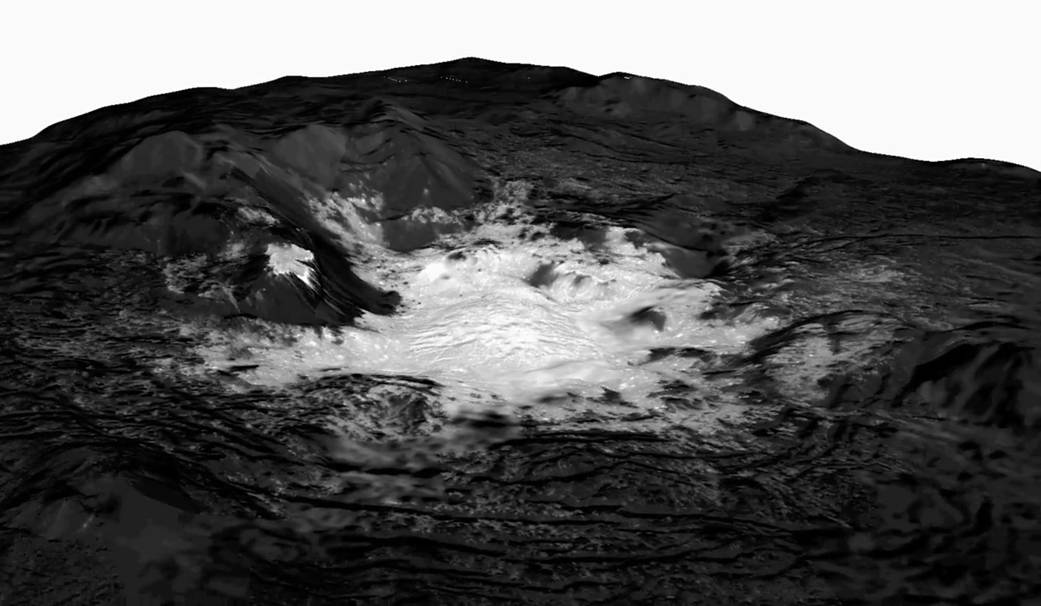
White material spreads across a patch of dark, rugged ground. Part of it rises slightly in the middle. Around its edges the bright material meets dark slopes along an intricate boundary. It could be a snowy mountain valley. In fact, it lies inside Occator, an impact crater on Ceres, the dwarf planet orbiting between Mars and Jupiter. The bright feature is called Cerealia Facula.
Seen from far away, these white patches might look like a mysterious glow. Researchers began by asking why material that reflects sunlight better than its surroundings had collected here. There was no need to assume it gave off light of its own. Images, spectra and gravity measurements from the Dawn spacecraft let them investigate what the material is and how it could have reached the surface from below.
1. A perspective assembled from photographs and a terrain model
As NASA’s description of the image explains, the main illustration is a mosaic of pictures Dawn took close to the surface of Ceres, some from an altitude of about 35 kilometers. The team draped the mosaic over a terrain model built from observations made at about 385 kilometers altitude. This gives us an oblique view with no added vertical exaggeration.
A camera did not take this landscape picture in a single exposure from the spot where we seem to be standing. The pattern of bright and dark comes from observations, while the model supplies the viewpoint. The white background at the top does not mean Ceres has a white sky. Knowing how the view was constructed helps us distinguish the edges of the rendering and its empty background from physical features.
Look first at the broad bright area in the center, the rises and dips within it, and where it meets the dark ground. This is a close look at a bright feature inside Occator. Taking the width of that bright patch for the diameter of the entire crater would give you the wrong scale. It helps to consult a map alongside a close-up.
2. An interior more complex than a small lump of asteroid rock
NASA’s overview of Dawn’s findings at Ceres describes a nearly round body about 940 kilometers across. Ceres is in the main asteroid belt, yet neither the material near its surface nor the density structure of its interior fits a uniform lump of rock. Here we can study traces of how rock and water-bearing material came to be distributed differently over time.
Along with images, Dawn gathered data on mineral composition, the distribution of elements, gravity and topography. A conspicuous bright spot is a good place to start asking questions. On its own it tells us neither how much water is inside nor where it is. Density data and observations of substances that point to water give us different ways of investigating the same world.
A water-rich world need not have lakes at its surface. Water can be ice, be bound up in minerals or, under certain conditions, be present as a liquid containing dissolved salts. Without asking which form is meant, it is easy to picture Ceres as a miniature Earth. The image shows no open sea or river.
3. Brightness tells us about both the material and the light
Set white paper on a dark floor and the paper looks brighter even though both receive the same sunlight. How much light a material reflects matters in images of Ceres too. But the direction of the incoming sunlight, the slope, shadows and the way camera data are processed all affect the recorded light and shade. A brightness value by itself cannot name a substance.
An impression from a photograph cannot settle whether the spots are water ice or salt. Even on Earth, snow, white sand and salt can look much alike from a distance. Researchers consider possible materials, then compare how each responds to light of different wavelengths. Differences invisible in an ordinary photograph can emerge when the wavelengths are examined separately.
Finding a bright area is one step. Interpreting it as a particular mineral takes another. A plausible explanation does not automatically rule out other substances. The spots are interesting for more than their unusual appearance. They show how additional measurements can narrow down the candidates.
4. A spectral clue to sodium carbonate
NASA’s report on the composition of Occator describes how Dawn’s visible and infrared mapping spectrometer, VIR, examined the bright material. Sodium carbonate was identified as the main constituent of the bright central area. It is a salt made up of sodium, carbon and oxygen, chemically different from sodium chloride, the salt we use in the kitchen.
Spectroscopy separates light by wavelength to see which bands are more strongly absorbed or reflected. Comparing the spacecraft data with mineral signatures measured in the laboratory helps researchers evaluate possible constituents. Naming the compound more precisely than just “salt” lets us ask what environment and processes could have produced it.
The composition report includes a separate analytical image in which red marks areas rich in carbonate. This color maps abundance. It does not show a surface glowing from heat. The black-and-white perspective at the top of this article contains none of that analytical red. Distinguishing a photograph of landforms from a map of composition lets the two add complementary information about the same place.
5. Following material from below through the deposits it left
When salts dissolve in water, solids can remain after the liquid disappears. Think of the white trace water sometimes leaves as it dries on Earth. A deposit can mark where liquid once traveled. At the low pressures and temperatures on Ceres, however, freezing and transitions to gas also matter. A warm puddle drying on Earth is only a partial analogy.
Results summarized by NASA in 2020 link the bright deposits at Occator to brine that rose from below. Brine is water containing dissolved salts. Using data that included gravity and topography, the researchers inferred a deep reservoir of brine. The spacecraft’s camera did not photograph the underground liquid.
The concentration of bright material near the center gives us a starting point for tracing those pathways. Researchers consider what accumulated where, which fractures are present, and when the deposits formed relative to surrounding landforms. The deposits alone cannot reveal the exact time or speed of the ascent. But they give us grounds to look beyond the idea that the material has simply always been there.
6. An impact can open paths to the interior as it digs a crater
Occator is an impact crater, so the impact itself merits a closer look. A large collision can excavate ground, heat and break the surrounding material, and open cracks. If those cracks provide pathways for material underground, the changes that follow the collision can tell a longer story than the shape of the pit alone. The impact helps explain how salt could have traveled here.
NASA’s account distinguishes material melted at relatively shallow depths shortly after impact from material rising from a deeper, longer-lived brine reservoir. Even as the impact heat faded, fractures reaching to depth could have allowed material to keep moving. A single brief episode is unlikely to tell the whole story of a bright feature.
This does not make upwelling brine a rule for every impact crater. The outcome depends on how much water or ice was there to begin with, the temperature, the properties of the rock, and how long pathways remained open. Similar-looking pits in different materials can preserve different geological histories. On Ceres we learn more by considering impact traces and chemistry together.
7. The age of a feature is a different question from the sharpness of its image
A sharp photograph can make a landscape look freshly formed. But sharpness tells us about viewing distance and instrument performance. It does not date the terrain. The Dawn team’s account of the landforms examines specific features, including a dome and fractures in the bright area, for evidence of geological activity after the impact.
Boundaries between features help establish the order of events. Where a deposit covers some other terrain, the covering material must have settled there after the surface beneath it existed. Putting events in that relative order is different from saying how many years ago they occurred. Numerical ages require other observations and models.
“Recent” in studies of the deposits also needs a geological time scale. A feature young in comparison with an ancient planetary surface is a long way from a photograph of water flowing today. Even a suggestion that activity might persist should be traced to the material or landform behind it. There is no jet of erupting water in this image.
8. Starting with a photograph and bringing other observations together
| Question | Evidence to examine |
|---|---|
| Where has bright material collected? | Camera images and terrain mosaics |
| What is its main constituent? | Visible and infrared spectra |
| How is subsurface structure inferred? | Gravity, topography and models of internal density |
| When and in what order did deposits form? | Relationships between deposits and fractures, and models of age |
Following these questions makes it easier to see where the photograph’s reach ends and the other data take over. The white area in the center records an actual bright feature. Its identification as salt comes from composition analysis. The movement of underground brine is an interpretation that draws on several kinds of measurement. Connecting these steps opens a window onto the past of the dwarf planet’s interior.
The white spots on Ceres are clues to a long interaction between water, rock and salts on an unfamiliar world. When you return to the image, look beyond the color to where the material collected and its boundaries with the surrounding terrain. The surface of this small, seemingly quiet world preserves a record of matter that rose from its interior and of events that have come and gone.