
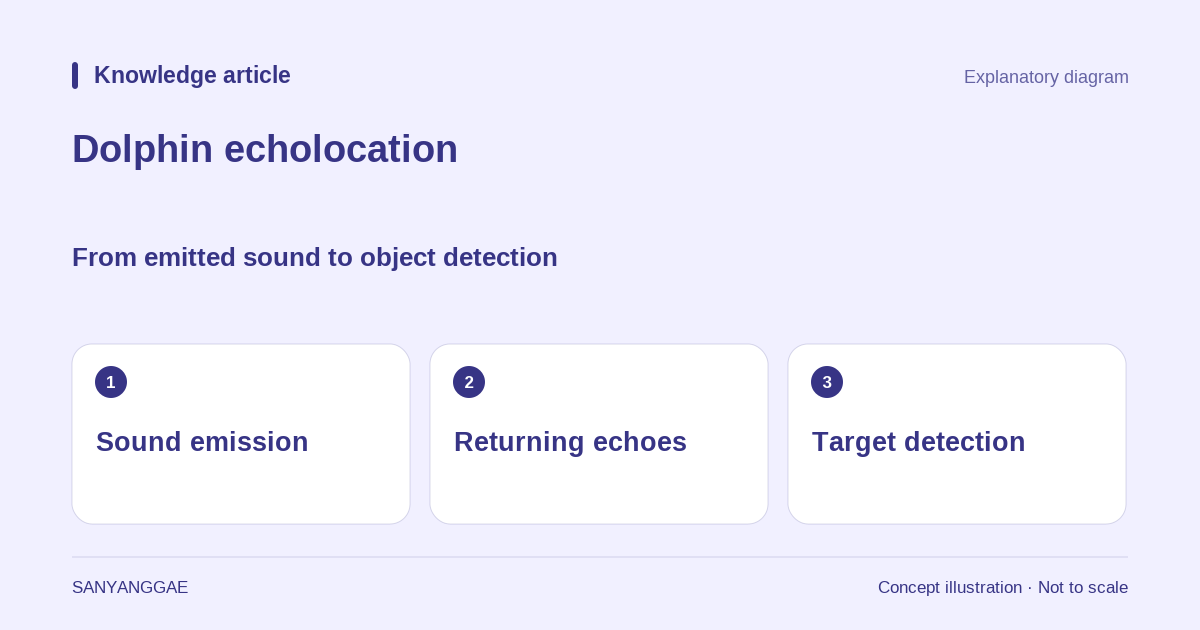
Watching a dolphin find prey in murky water calls to mind the idea of “seeing with sound.” Echolocation is the ability to send sounds and use the returning signals from objects to gather information about the surroundings. There is no confirmation that a dolphin experiences a picture just like ordinary vision, and dolphin sounds have a range of functions. Distinguishing sound production, transmission, echoes and the data recorded by researchers makes it easier to appreciate the ability and its limits.
1. Sending a sound and using its return time
In echolocation, a short sound spreads through the water, strikes an object and partly returns. The time it takes and the features of the echo help indicate the object's position and properties. Sound has to make a round trip before the echo is available. A return from a more distant target can be weaker, and other reflections can also be present. A simple model of distance measurement is a starting point for a more complex sensory environment.
An echo in a hallway can illustrate the principle, but a human voice in air and a dolphin signal underwater travel under different conditions. Water temperature and salinity, among other factors, affect sound transmission underwater. An arrow in a diagram may point to one fish even though the seabed, other animals and the water surface can also reflect sound. Alongside the sound itself, pay attention to how dolphins might distinguish useful information in a mixture of returning signals.
2. The head and jaw play a role in acoustics
Dolphins have structures in the head involved in producing and transmitting sounds. The melon in the forehead is associated with how the outgoing signal is directed. Returning sounds can be transmitted to hearing structures through specialized fatty tissues around the lower jaw and other pathways. Dolphins can hear despite having external ears unlike a person's. The melon should likewise not be treated as a direct equivalent of an eye or camera lens.
In an anatomy diagram, distinguish the direction the sound travels out, the direction it returns from and the stages leading to the nervous system. Drawing the melon as the sole hearing structure or claiming the forehead produces and completely interprets the signal mixes up these roles. Details can vary by species and study conditions, so avoid claiming identical structures and performance for every dolphin. A similar outward appearance does not tell you that the range and use of the senses are always the same.
3. Clicks and whistles can have different functions
Dolphins produce clicks, whistles and other sounds, using acoustics for echolocation and social communication. An echolocation click does not identify the prey the animal was seeking, and a recorded whistle cannot be directly translated into a sentence. Interpreting vocalizations requires information about behavior, context, individuals and groups. Diverse vocalizations and the claim that they amount to human language are very different ideas.
Check whether audio in a research video is played at its original frequencies and speed. It may be shifted in frequency or slowed down to make it audible to people. Captions alone cannot establish that a short signal is a greeting or command. Knowing the original recording conditions and any processing helps clarify what can be inferred. Listening to dolphin sounds and scientifically classifying their functions can happen together, with different evidentiary standards.
4. Vision and sound contribute different information
Dolphins also use vision, and the usefulness of each sense varies with water clarity, light and distance to the object. Echolocation does not make the eyes unnecessary or demonstrate that dolphins always act on sound alone. When prey moves and objects overlap, continuously changing information can matter more than an isolated signal. “Seeing with sound” is a helpful metaphor for the role of the sense. What dolphins actually experience and how they experience it remain distinct research questions.
For an experiment involving avoidance of obstacles in dark water, ask how light and vision were controlled, whether the animal had learned a route, and what signals researchers measured. A successful action does not disclose the whole decision process. Difficulty under one condition also does not establish a general lack of ability. Reading sensory research accurately means keeping conclusions within the range of behavior the experiment tested.
5. An underwater microphone records sound, not what the animal thinks
Researchers use hydrophones and other sensors to analyze sound timing, direction and location. Differences in arrival times across hydrophones can help estimate where a sound was produced, and long recordings give clues about distribution and activity. A missing recording cannot prove that an animal was absent. Instrument sensitivity and placement, background noise and whether the animals were vocalizing all affect detection.
To read an acoustic graph, first check the axes and what the colors represent. Intensity at different frequencies is a different measure from animal abundance. A strong signal does not necessarily come from a large animal or many animals. It might also reflect distance to the equipment. Changing the color scale for the same data can change the impression, so visual drama should not be read directly as intensity of behavior. Distinguish hearing a sound from establishing where it came from and what it did.
6. Noise and responsible observation
Noise from vessels and other human activities can affect how animal signals travel and the acoustic conditions in which animals hear. Effects vary with sound level, frequency, duration, distance, species and behavioral context. One figure cannot explain all situations. Sound travels readily underwater, which helps make this sensory ability possible and exposes animals to changes in their acoustic environment. A response in a single scene cannot by itself establish the full extent of long-term harm.
Follow local guidance and safe observation standards instead of pursuing dolphins closely or playing sounds to provoke a reaction. Entering the water or supplying food can change the animals' lives. When sharing footage, retain the species, location, any audio processing and what the study actually confirmed. The appeal of echolocation goes beyond the idea of a superpower. It becomes clearer when we understand how dolphins make sounds, receive echoes and interpret information from their surroundings.