
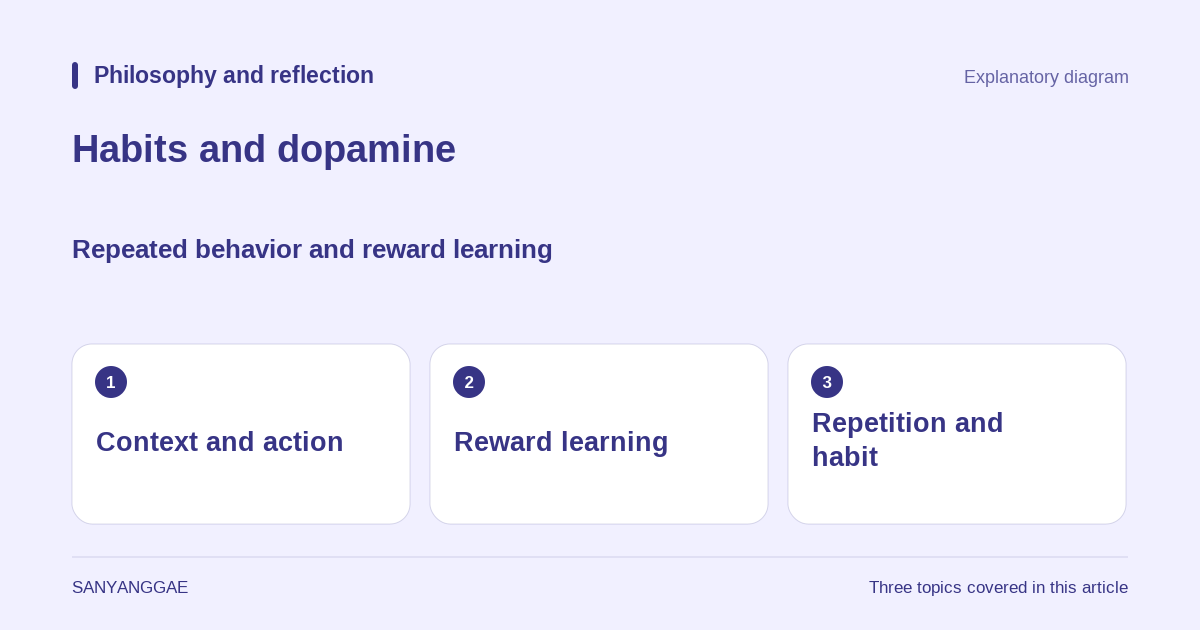
A habit is more than an action performed many times. Researchers study behavior that takes place relatively automatically in response to cues in a recurring situation. Invoking neuroplasticity or dopamine does not by itself establish that a particular routine works.
1. Connecting a situation with an action
If you open a book in the same place every day, the time, the place and the preceding activity can all serve as cues. To apply this idea, specify what you will do and under what circumstances, rather than simply writing “read regularly.” You can observe both how often you repeat the action and which aspects of your surroundings make it harder.
2. Dopamine is not a happiness score
An important idea in dopamine research concerns signals about the difference between an expected reward and the actual outcome. Reducing dopamine’s role to pleasure omits much of its function. Nor does how you feel measure how much dopamine your brain has released. Connecting neural activity observed in an experiment to everyday experience requires examining the conditions under which that connection holds.
3. Evaluating a plan in everyday life
Record whether you started and completed the action and what was happening when it stopped. A timetable that says all habits form within 21 days cannot be applied generally. Assess whether a plan to repeat a small action fits your life, and adjust it. An explanation of habits should not serve as instructions for self-treatment of a mental health problem.
4. Observing cues and obstacles to reading
Imagine a reader who intends to read every evening but often forgets. Saying “I lack willpower” gives no indication of the circumstances in which behavior changes. Instead, note whether the dinner table has been cleared, which room the book is in and whether the reader checks a phone before starting. The point is to examine the actual starting conditions, without passing judgment on the person. This is an example of making a plan concrete, not a result from a research participant.
Define the initial action in observable terms. “After clearing the table, open the book and read one paragraph” works better for this purpose than a distant outcome such as finishing the book. Leaving it where you plan to read saves the effort of looking for it. This change to the surroundings is intended to ease the start. It provides no evidence that a particular brain region has been activated. Record a day when time was short separately from one when the book could not be found.
Reading while deliberately thinking about a goal differs from opening a book almost automatically in response to a cue. Both may support reading, but they do not both have to mean habituality in the research sense. A record of more frequent reading does not show that goal-directed decisions have completely disappeared. Reflecting on the goal and revising the plan still matters when changing behavior.
5. Separating reward prediction error from everyday mood
Reward prediction error concerns the difference between a received and an expected reward. Researchers can examine how a learning signal changes when an unexpected outcome occurs in a setting where the same result was consistently expected. Schultz discusses the timing of these signals and the associated neural activity. This account does not exhaust all the functions in which dopamine participates, nor does the duration of a happy moment correspond one-to-one with the amount released.
Consider making a check mark after reading. You may feel a sense of achievement, but that is neither a measurement of dopamine nor a calculation of the size of a reward prediction error. Records can help answer “Does this small reward help me keep doing this?” A claim about what percentage increase in dopamine this action produces requires physiological measurement and a separate study.
Treat attempts to sort all activities into good and bad dopamine by stimulus intensity with caution. The same activity can serve different purposes at different times and in different settings. Turning off notifications may help create conditions for concentration. This does not show that you have detoxified the brain or reset its reward system. The usefulness of the change and the evidence for a neuroscientific claim need separate evaluation.
6. Finding a condition to change in a week’s records
Imagine that over a week you opened the book on four days and worked late and got home late on three. Before calling this success or failure at habit formation, examine the conditions on the days you did not read. If an evening-only plan clashes with your schedule, you could move reading to after lunch or define a separate minimum action for late days. Recording every missed opportunity as weak willpower hides conditions you could change.
Distinguish attempts from completions. Opening the book and reading only one paragraph because you were tired differs from never looking for it. Even if you did not reach your intended amount, the starting action took place. Conversely, sitting at the desk for longer without reading does not allow time at the desk to stand in for the intended behavior. Choose observations that match what you want to change.
Doubling the next day’s reading after a missed day is not always appropriate. A heavier burden may make it harder even to begin, so consider your schedule and purpose. Revising a plan may mean adjusting the conditions, with no implication of poor commitment. Habit research offers no single formula for all human behavior and no promise that one method will work at the same speed for everyone.
Even if keeping records coincides with a change in behavior, consider other influences. Your workload may have eased, or you may have picked a more interesting book. Everyday records inform small decisions and differ from a rigorous controlled experiment. Change few conditions at a time and allow for several possible explanations to avoid overstating what your experience shows.
Neuroplasticity is a broad term for the nervous system’s capacity to change. It cannot guarantee that a particular routine will permanently reconfigure the brain. The practical aim of a reading plan is to specify observable actions, recurring cues, barriers to starting and possible adjustments. Neuroscience can supply an interesting backdrop, but should not give the impression that you measured more precisely than your reading log allows.
Apply the same criteria when your environment changes, for example on vacation or after moving home. If reading was easy to sustain in the old place and then stops, consider whether the cues have changed before concluding that repetition was pointless. You may need to decide where to keep the book and when to start reading in the new setting. Counting past successes answers a different question from observing whether the action continues under current conditions. Focus on finding conditions that work in your life, even if the plan takes a different form.