
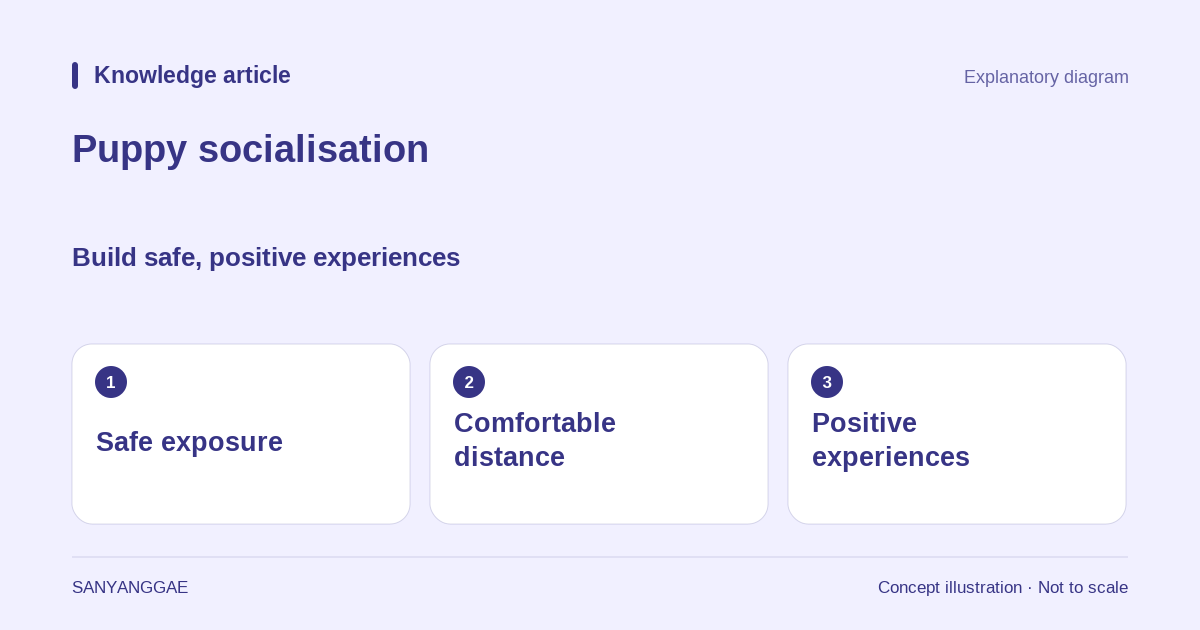
Socialising a young puppy is not a race to encounter as many unfamiliar things as possible within a limited period. It helps the puppy experience people, animals, sounds and surroundings at an intensity it can manage, in preparation for everyday life. A growing count of experiences is not desirable learning if they repeatedly cause strong fear. Considering development, infection risk and the individual's responses supports a personal plan between avoiding everything until vaccinations finish and taking the puppy everywhere regardless.
1. An important period means paying attention to experience quality
AVSAB identifies early puppyhood, particularly the first three months, as important for socialisation. Experiences then can affect later responses, but this does not mean a door closes on all learning after a particular date. Safe, positive experiences can continue afterwards. Starting points and reactions differ with development, health and previous experience. Do not set intensity from an age chart alone.
Missing early experiences need not be treated as a carer's failure. Discovering what currently feels comfortable or difficult is more helpful for the next plan. For example, taking a puppy adopted later to a different event every day to catch up quickly can reduce recovery time. The goal is not a dog unresponsive to every stimulus, but experience of exploring everyday situations, keeping distance when needed and becoming settled again.
2. Review individual risks when choosing places and vaccination plans
Discuss vaccination and immunity, local infection risks, hygiene and the health of animals the puppy will meet with the veterinarian. Some experiences can be arranged safely before all vaccinations are complete, but that does not make every location suitable. Floors frequented by many unknown animals may present different risks from managed spaces. Do not use one internet vaccination chart or another household's permitted date as the decision for this puppy.
At the first appointment, ask practical questions: which local places should we avoid, which experiences are possible, and how should meetings with familiar healthy dogs begin? Observation outdoors without being placed on the ground and experiences of household sounds can be considered according to circumstances. Every method still needs rest and choice. Infection safety does not justify overwhelming exposure, and an apparently low fear response does not remove the need to assess hygiene and health.
3. Adjust distance, sound level and duration
Intensity depends on distance, movement, volume and duration as well as the kind of stimulus. Watching an unfamiliar person from a distance and being picked up immediately are different experiences. Start where the puppy can investigate and continue easy behaviours; reduce intensity if it stiffens or tries to hide. Taking food is one clue, but eating alone does not prove an absence of tension.
For a vacuum cleaner, consider an easier distance and sound level instead of switching it on suddenly beside the puppy. When approaching a person, ask them not to reach first and leave an escape route. Avoid restraining a fearful dog to “prove” the stimulus is harmless. Whether exploration and recovery are possible at the next encounter matters more than the number of repetitions of a sound.
4. Select experiences needed for actual everyday life
Include family, visitors, the entrance and carrier, usual routes, varied safe surfaces and gentle handling needed for veterinary care. There is no need to compete over fixed numbers of every hat, person or vehicle. Pulling a tail or pressing painfully is not practice for becoming comfortable with children or the clinic. The experience list is not a test of enduring discomfort.
Offer household sounds and objects at an easy intensity, with sufficient rest after brief experiences. The puppy need not greet every dog on a walk; passing quietly or watching at a distance is useful too. In a home that often uses a lift, for example, consider doorway sounds and movement separately from distance to people. Starting with manageable conditions instead of solving every element at once makes the next plan more specific.
5. Assess classes and meetings with other dogs
Check health and vaccination requirements, hygiene, space, supervision and opportunities to withdraw and rest when choosing a class. Releasing dogs of different sizes and play styles together without distinction is not the same as good socialisation. Even in fast chasing that looks enjoyable, watch whether one puppy is always fleeing or hiding and whether the other stops when it wants a break. Quiet stiffness should not be interpreted as calm adjustment.
Instructors should use reward-based methods, recognise limits concerning fear and aggression and recommend veterinary assessment when necessary. Do not follow advice that social skills require sharp lead corrections, startling noises or forced submission. Ending the session or reducing difficulty must be possible when the puppy struggles. Paying for a class is not a reason to make it endure until the end. An individual plan in another format may suit a puppy that finds group classes difficult.
6. Record responses and next steps rather than completed counts
Separate the experience, starting intensity, observed behaviour, subsequent recovery and next plan. “The visitor did not approach first; the puppy sniffed from a distance, then returned to play” is more useful than ticking “met a visitor”. It helps decide whether to repeat that intensity or provide an easier distance. Remember that sounds, place, fatigue and preceding activity may also affect comparisons.
If the puppy hides today in a place where it was comfortable yesterday, examine people, noise, health and fatigue rather than calling it weak-willed. Consult a veterinarian and a reward-based behaviour professional about repeated fear, aggression or avoidance interfering with daily life. Returning to manageable conditions, rather than rushing to add encounters, builds the next learning opportunity. Socialisation does not end with completing a list: it is ongoing care that adapts safe experiences to changing responses during growth.