
1. Seeing something float does not establish that gravity is absent
When people remain suspended inside a space station and released objects float beside them, it is tempting to think Earth's gravity does not reach that far. But Earth's gravity acts on a station orbiting Earth too. It is important to distinguish how a person moves within the station from how the station as a whole moves relative to Earth. Against the cabin, a person may appear to float almost in place, while both person and cabin accelerate toward Earth and move together along an orbit. NASA's explanation of microgravity likewise distinguishes the observer's frame of reference when explaining floating.
Free fall is the starting point for understanding this situation. Ideal free fall means motion under gravity alone, neglecting the effects of other forces. A station, a nearby person and an object released from a hand can move with nearly the same gravitational acceleration. They are falling together without the floor having to support the person continuously as it does on the ground. An object floating inside the cabin is therefore not evidence that it is stationary relative to Earth. It indicates little relative motion between the station and the object, which is different from saying gravity has disappeared.
2. Mass, gravitational force and a scale reading answer different questions
Mass is related to how difficult it is to change an object's state of motion, and it does not disappear when the object reaches a station. The magnitude of the gravitational force on an object depends on its mass and the gravitational acceleration at its location. In a simple expression, that force is mass multiplied by gravitational acceleration. NASA Glenn's free-fall guide uses this relationship to distinguish mass from gravitational force, which varies with location. The upward support force on a person standing still on a floor is a different force from gravity. We experience our usual sense of weight through support transmitted to our feet and joints.
An ordinary bathroom scale likewise does not directly capture and count gravity; it displays a reading based on force transmitted between a person and its platform. If person and scale ideally fall freely together without pressing on each other, the reading can be almost zero. Gravitational force has not become zero. Stating whether weight means gravitational force or apparent weight produced by support helps prevent confusion. Mass also remains: accelerating a large floating piece of equipment by the same amount in the same time, or stopping it, requires a greater force than for a small object. Floating does not remove its inertia.
3. An orbit is continuous falling while moving sideways
Why, then, does a freely falling station not immediately hit the ground? Its falling toward Earth is accompanied by sideways motion. As the station moves forward, gravity continually curves its direction of travel. For an orbit with a suitable position and velocity, the ground beneath also curves away with Earth's surface, so the falling path continues around Earth without meeting the ground. Imagining the station hanging motionless over a single point on Earth misses this relationship. Beyond the background of a video showing floating people, the station as a whole continues its rapid orbital motion.
Acceleration here does not mean only an increase in speed. Even circular motion at constant speed involves acceleration because the direction changes, and Earth's gravity changes the direction of orbital motion. Explaining that gravity and a real outward force cancel, leaving the station stationary without force, therefore reverses the explanation. A rotating reference frame can introduce the inertial force called centrifugal force, but this must be distinguished from the actual force required when describing the orbit relative to Earth. The station does not keep its engines running continuously to avoid falling; it continues a fall whose path is curved by gravity.
4. Microgravity does not mean a perfectly undisturbed space
The name microgravity should not be read as saying that Earth's gravitational field vanishes inside the station or becomes a fixed small fraction of its usual value. The focus here is on the small accelerations and disturbances remaining in an experimental environment that falls freely together. A real station is not an ideal point; it is a structure containing moving people and machinery. Crew movements and equipment vibrations can travel through that structure, while station rotation and the external environment also affect experimental conditions. The absence of an obvious downward fall does not establish identical conditions at every location and every moment.
NASA Glenn describes systems measuring vibrations and transient accelerations from crew, vehicles and equipment, and systems measuring small accelerations associated with atmospheric drag, station rotation, water releases and other causes. Researchers use these data to assess the environment in which an experiment occurred. When reading microgravity results, examine which disturbances were measured and managed as well as the statement that the work took place in space. Pushing an object by hand can produce relative velocity through contact force at that moment; its later drifting cannot be explained simply by saying there is no gravity. Consider both the basic free-fall model and the forces experienced by the real apparatus.
5. How is propulsion for orbital correction related to free fall?
Extremely thin atmosphere remains at the station's orbital altitude. Drag as the station passes through this gas affects its orbital motion and, over time, causes the orbit to lower. NASA's International Space Station reference describes altitude loss from atmospheric friction and orbital reboosts using periodic rocket firings. Propulsion is therefore important to establish and maintain an orbit. But this should not be confused with why people usually float. Gravity curving the orbital path and drag changing the orbit so that it needs replenishment are connected phenomena, but they are not the same explanation.
When thrusters operate, thrust transmits force to the station's structure. An object not attached to the structure does not directly receive that same force, so it may appear to move relative to the cabin. The idealization that station and person follow the same motion under gravity alone cannot be applied unchanged then. Paths through which contact transmits force, such as equipment mounts and crew handholds, also matter. Differences between ordinary floating scenes and scenes during orbital correction do not contradict the free-fall explanation. They show why one must first establish which forces can be neglected in a particular situation.
6. Research on Earth also creates periods of falling together
If studying microgravity required gravity to be absent, the same principle could not be used on Earth. In practice, specialist drop facilities can create conditions of shared free fall while dropping experimental equipment, as can research aircraft during designated parabolic flight segments. They do not switch off Earth's gravity; they obtain a period of reduced support force by allowing the experimental subjects to move under gravity. Not all the time an aircraft is flying or a drop facility is operating is a microgravity interval. Preparation, recovery and stopping phases must be distinguished from the portion used for research.
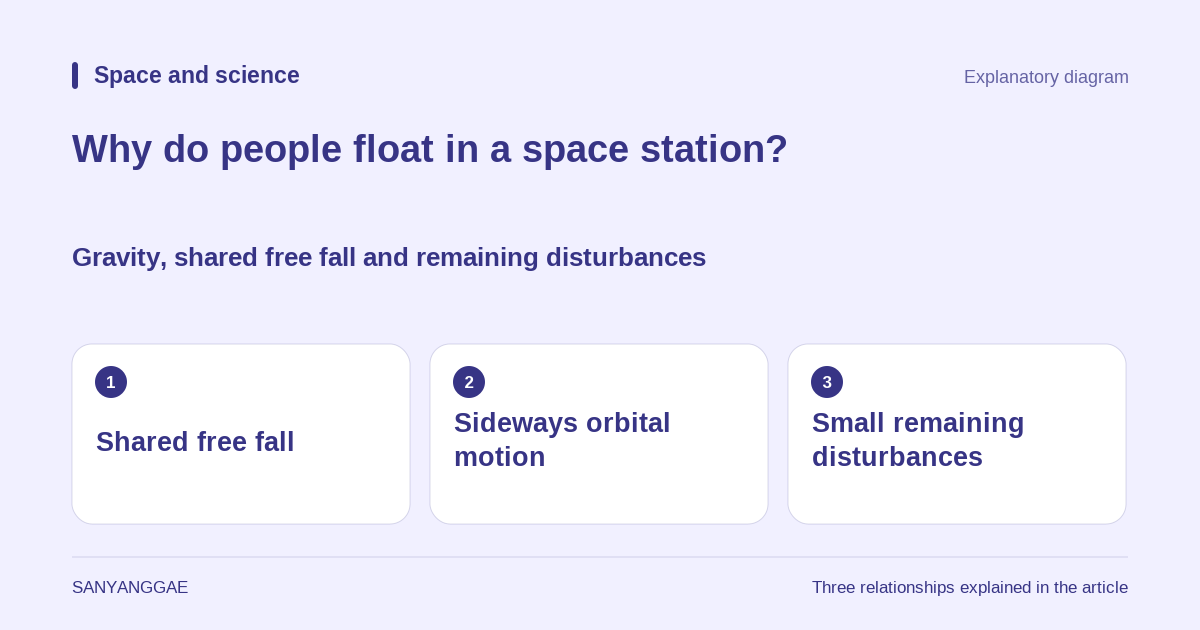
The dimensions of these facilities and their flight paths limit the available duration, and the work takes place with specialist equipment and safety management. It should not be interpreted as an experiment to imitate by dropping people or objects from heights in everyday spaces. When interpreting photographs or videos, consider the reference frame, the objects falling together, contact forces and small disturbances in turn. This article's original explanatory diagram organizes the relationships among three topics: shared free fall, sideways orbital motion and the small disturbances that remain. It is not a reproduction of an actual trajectory or acceleration measurements, but a guide to conditions that a floating scene alone cannot establish.