
Aloe vera
Aloe vera is a perennial succulent with thick leaves arranged in a rosette. Its leaf shape and young offsets provide a way to observe growth adapted to dry environments.
- Scientific name
- Aloe vera (L.) Burm.f.
- Family
- Asphodel family · Asphodelaceae
- Other names
- Aloe vera · Aloe barbadensis
- Reviewed
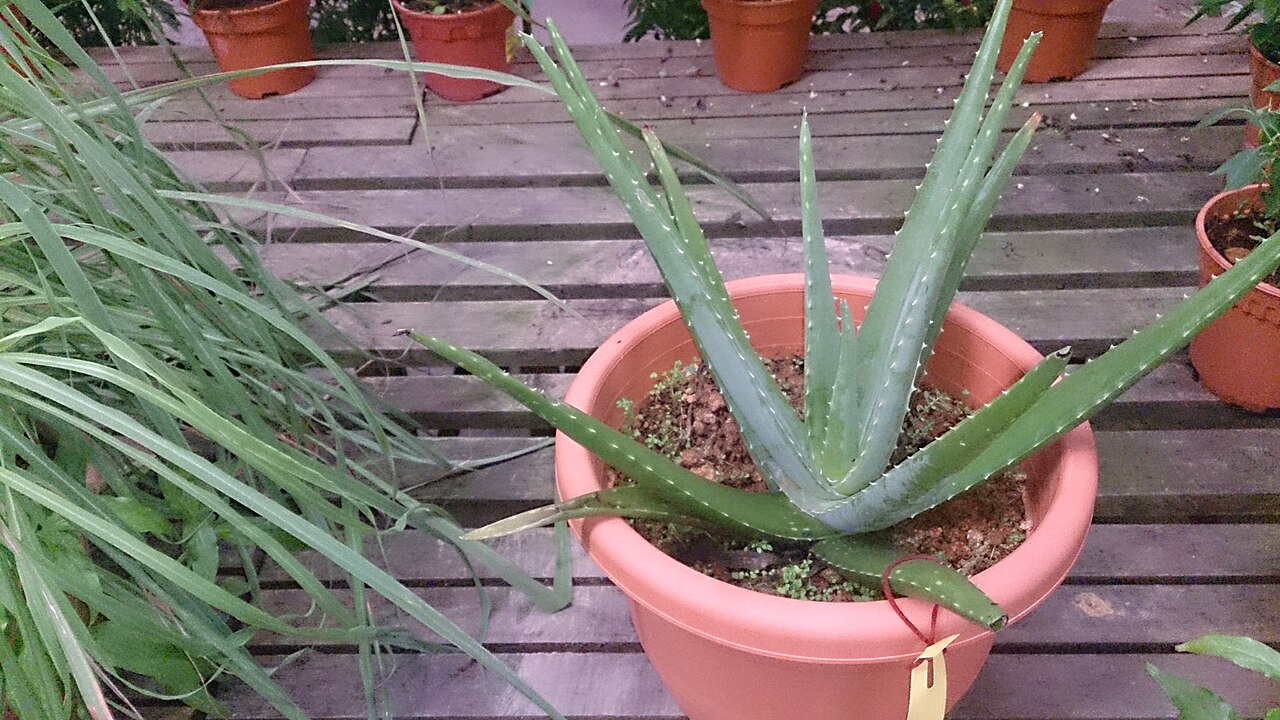
The photograph shows the rosette of a potted Aloe vera. It does not show flowers or the water-storage tissues inside the leaves.
Photo credit: Mokkie
License: CC BY-SA 3.0
A Wikimedia-provided reduced JPEG is used; no local resizing, cropping, colour changes or format conversion was performed.
Names and classification
Aloe vera belongs to Asphodelaceae. The older name Aloe barbadensis also appears, but other aloe species and similar-looking agaves should not all be treated as the same plant.
Observable features
Thick, pointed leaves form a rosette and have small teeth along their edges. Mature plants can produce stalks bearing tubular flowers, while leaf spotting may vary with growth stage.
Distribution and habitat
Its native range is in the dry, rocky Hajar Mountains of northern Oman. Elsewhere it is planted in pots or gardens, but outdoor overwintering conditions cannot simply be transferred to colder regions.
Ecology and life cycle
Water stored in its thick leaf tissues helps this succulent live in dry conditions. It also spreads by offsets around the base, so distinguish division of these plants from reproduction through flowers and seeds.
Cultivation and care
Provide ample light, well-drained soil and a pot with drainage holes. Water according to soil dryness and season, avoiding prolonged wetness that can cause root rot.
Observation and use precautions
Take care around the leaf-edge teeth and keep children and pets from chewing the leaves. Do not use an ornamental plant’s leaves or sap as food or treatment; this article gives no medicinal or consumption instructions.