
Greater duckweed
Several fine roots hang beneath each small green disc on still water. A smaller disc attached to its side is a young plant.
- Scientific name
- Spirodela polyrhiza (L.) Schleid.
- Family
- Arum family · Araceae
- Other names
- Giant duckweed · Great duckweed
- Reviewed
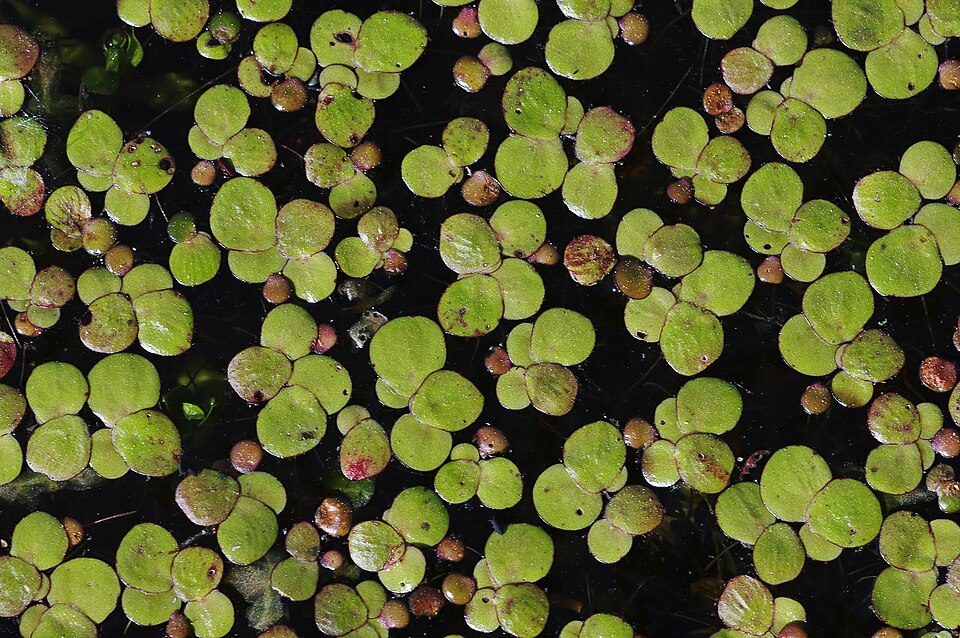
Seen from above, this pool in Lower Saxony, Germany, shows small fronds attached to larger ones. The submerged roots are difficult to count from this angle.
Photo credit: Christian Fischer
License: CC BY-SA 3.0
The 960-pixel-wide JPEG thumbnail supplied by Wikimedia was used without further editing.
Names and classification
Greater duckweed (Spirodela polyrhiza) is a flowering plant in the arum family. Its flat, leaf-like body is called a frond. Flowers are rarely seen.
Observable features
Pick out one round or broadly oval frond and look underneath. Greater duckweed has several roots per frond, while members of the genus Lemna usually have a single root.
Distribution and habitat
It floats on fresh water in ponds and slow-flowing ditches. In Korea it also occurs in rice paddies. Its roots need not reach the bottom.
Ecology and life cycle
Daughter fronds grow from the sides of a mother frond and stay attached for a time. Where winters are cold, resting buds can sink to the bottom and survive until the next growing season.
Cultivation and care
If you grow it in a clear container, look alternately from above and from the side. From above you can see where a daughter frond joins its parent. From the side you can trace the roots of a single frond.
Observation and use precautions
When fronds overlap, it is easy to count a neighbour’s roots. Look for an isolated frond at the edge of a group. Keep the plants and their water out of other ponds.