
Japanese zelkova
Japanese zelkova is a deciduous East Asian tree with toothed leaves and a broad crown. Examining leaf arrangement, veins and bark together helps distinguish it from similar trees.
- Scientific name
- Zelkova serrata (Thunb.) Makino
- Family
- Elm family · Ulmaceae
- Other names
- Zelkova serrata
- Reviewed
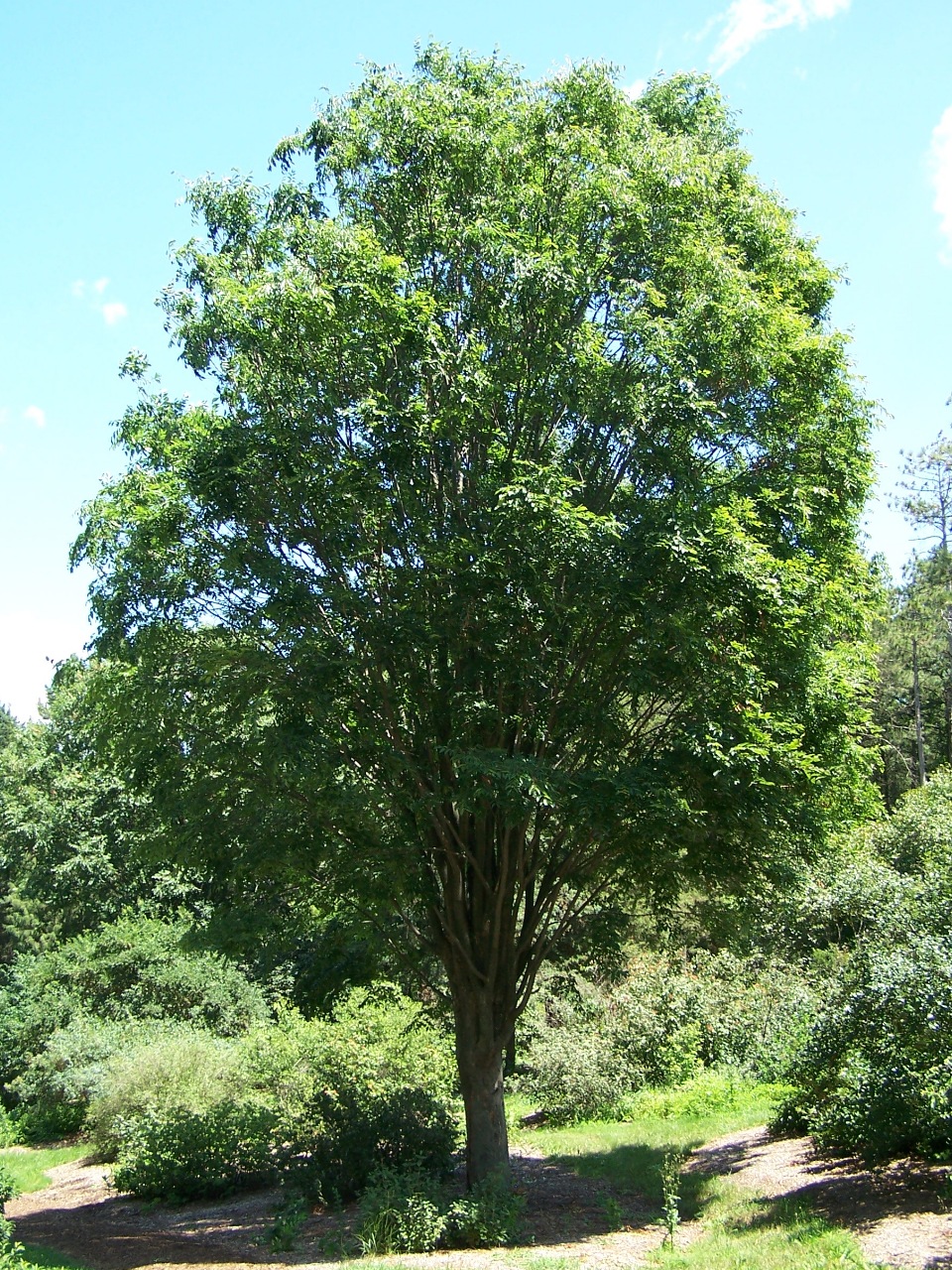
A whole Japanese zelkova planted at the Morton Arboretum. The photograph shows its spreading branches and crown, rather than a close-up of leaf teeth.
Photo credit: Bruce Marlin
References: http://www.cirrusimage.com/tree_Japanese_zelkova.htm
License: CC BY 3.0
The original JPEG is used without changes.
Names and classification
Japanese zelkova, Zelkova serrata, belongs to Ulmaceae and is native to East Asia, including Korea, China and Japan. It is planted in parks and streets, but is distinct from elms in the same family and from hornbeams with similar leaves.
Observable features
The leaves alternate along the branches and have toothed edges, with lateral veins extending towards the teeth. Examine the leaves alongside the upward-spreading branches of young trees, the broad crowns of older trees and their patterned bark.
Distribution and habitat
Its native distribution in temperate East Asia must be distinguished from locations where it is planted on other continents. In a garden, consider sunlight, soil space for roots and room for the mature crown together.
Ecology and life cycle
The inconspicuous flowers and small fruits can be observed alongside seasonal leaf changes. Autumn leaves may turn yellow, reddish brown or other shades, so the color of one tree should not be treated as fixed for the species.
Cultivation and care
Established trees tolerate some dryness, but this does not mean newly transplanted trees need no watering. Check sunlight, drainage and soil moisture, and leave enough clearance between expanding branches and nearby structures.
Observation and use precautions
Restricted root space along streets or in parking areas can cause stress, including crown dieback or cracked bark. Before cutting large branches or digging around roots, consider the long-term effects on the structure and growth of the shade tree.