
Korean rhododendron
Korean rhododendron is a deciduous shrub with pink to purple flowers that appear before its leaves in spring. It is native to East Asia, including Korea, and should be distinguished from other similar-flowered rhododendrons.
- Scientific name
- Rhododendron mucronulatum Turcz.
- Family
- Heath family · Ericaceae
- Other names
- Korean azalea · Rhododendron mucronulatum
- Names and classification
- BRIS lists 참꽃나무 as another Korean name for Rhododendron mucronulatum. In Korea’s national species list, it is the Korean name for a separate species, Rhododendron weyrichii.
- Reviewed
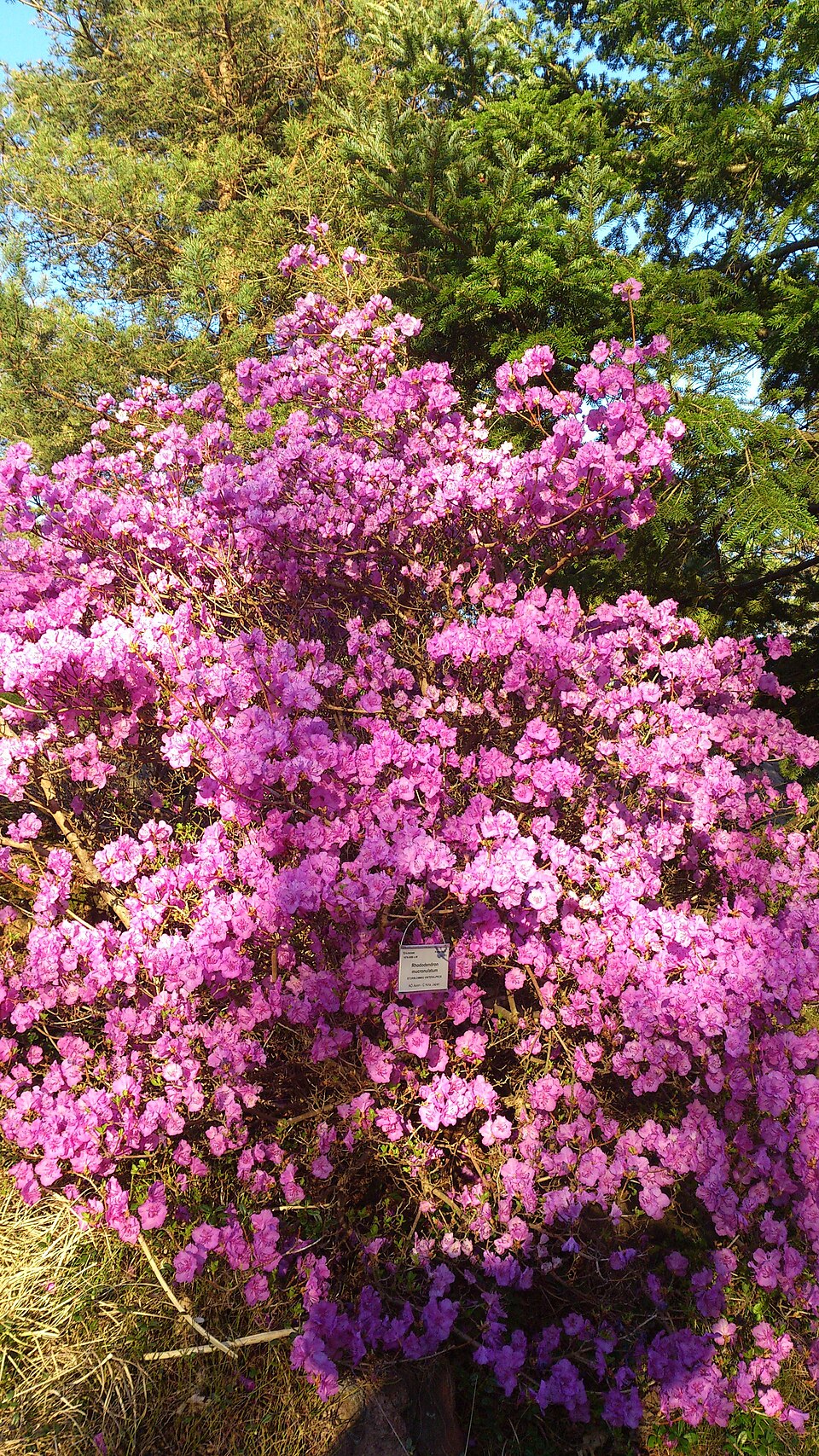
A Korean rhododendron planted in a botanical garden. Pink flowers visible before the leaves and a label are shown; this is not a photograph of a wild habitat.
Photo credit: Showman
License: CC BY-SA 3.0
A reduced-size JPEG supplied by Wikimedia is used, with no additional cropping or color changes.
Names and classification
Rhododendron mucronulatum belongs to Ericaceae. Its East Asian distribution spans the Russian Far East, China, Korea and Japan; seeing it in a garden on another continent does not make it native there.
Observable features
Flowers appear on the branching, multistemmed shrub before the leaves emerge, and their divided tips spread widely. Do not distinguish it from other azaleas by flower color alone: also check the order of leaf emergence, leaf shape and the scientific name on the label.
Distribution and habitat
It grows in mountains and around woodland in East Asia, including Korea, and is also planted in gardens. Flowering time varies with region and the weather that year, so a flowering month recorded elsewhere should not be applied unchanged.
Ecology and life cycle
The early spring flowers provide resources for visiting insects, but early bloom can also expose them to late frost. Following leaf growth after flowering and the formation of next year's flower buds helps explain the shrub outside its flowering season.
Cultivation and care
Maintain acidic soil and suitable moisture while checking drainage so water does not remain around the roots. Avoid excessive watering or fertilizer, and consider the period after flowering and the effects on the next flower buds when pruning.
Observation and use precautions
The name Korean azalea must not be taken to mean that all azaleas or ornamental cultivars are edible. Do not pick wild flowers for food based on color or photographs, and do not damage branches or flowers in parks and botanical gardens.