
Sweet potato
Sweet potato is a trailing crop in the morning-glory family, harvested for its swollen storage roots. Comparing it with the potato, whose harvested organ is a stem tuber, reveals a useful difference between plant organs.
- Scientific name
- Ipomoea batatas (L.) Lam.
- Family
- Morning glory family · Convolvulaceae
- Other names
- Ipomoea batatas
- Reviewed
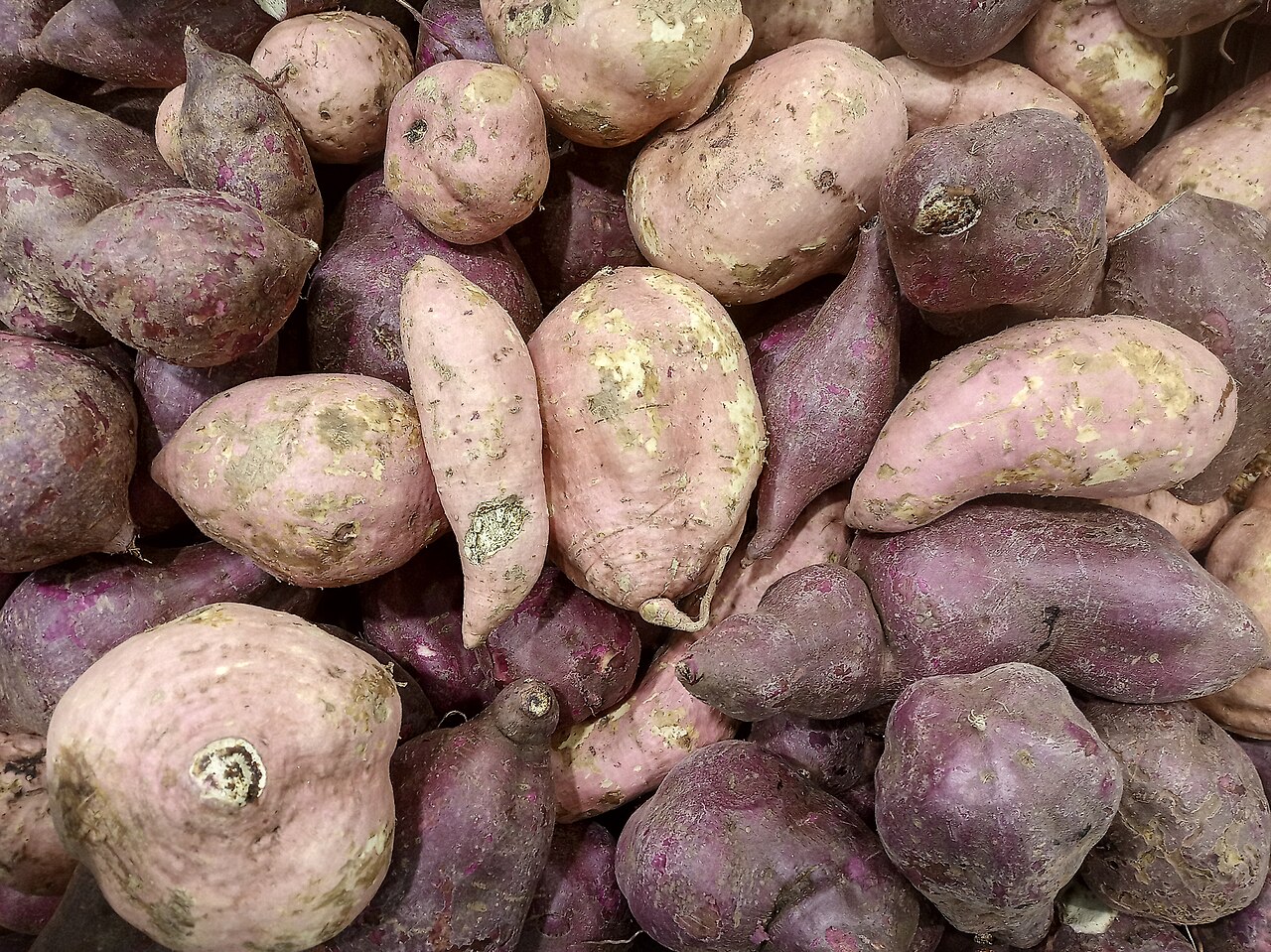
Harvested storage roots of sweet potato are shown. Leaves, flowers and cut flesh are absent, and these colors and shapes do not represent every cultivar.
Photo credit: Filo gèn' · © 2020 Studio lab 1
License: CC BY-SA 4.0
A reduced JPEG supplied by Wikimedia is used, with no additional cropping, format conversion or color changes.
Names and classification
The accepted name is Ipomoea batatas, in Convolvulaceae. Its harvested organ is a swollen storage root, differing in both organ and family from the stem tuber of the potato in Solanaceae.
Observable features
Stems spread along the ground, and leaves may be heart-shaped or divided into lobes. Skin and flesh colors of storage roots vary by cultivar, so purple skin alone cannot establish a species or cultivar.
Distribution and habitat
Its native range extends from Mexico to Venezuela and Ecuador, and it is cultivated in many countries. Frost sensitivity means it is often grown as a warm-season crop in temperate regions.
Ecology and life cycle
Roots arise from stems, and some thicken to store reserves. Farmers mainly propagate it using vine stem cuttings, while true seeds are also used in breeding.
Cultivation and care
Provide sunshine and well-drained soil, and plant healthy transplants after the last local frost. Allow room for spreading vines and avoid prolonged waterlogging around the roots.
Observation and use precautions
Distinguish cultivars grown for ornamental leaves from food-crop production, and check the labels of treatments used. Do not identify and eat other morning-glory relatives as sweet potato merely because their flowers or vines look similar.