
Venus flytrap
Venus flytrap is a carnivorous plant whose two-lobed leaf traps close around small prey. It is a photosynthesizing plant, not an animal living on insects alone, and its behavior is linked to life in nutrient-poor wetlands.
- Scientific name
- Dionaea muscipula J.Ellis
- Family
- Sundew family · Droseraceae
- Other names
- Dionaea muscipula
- Reviewed
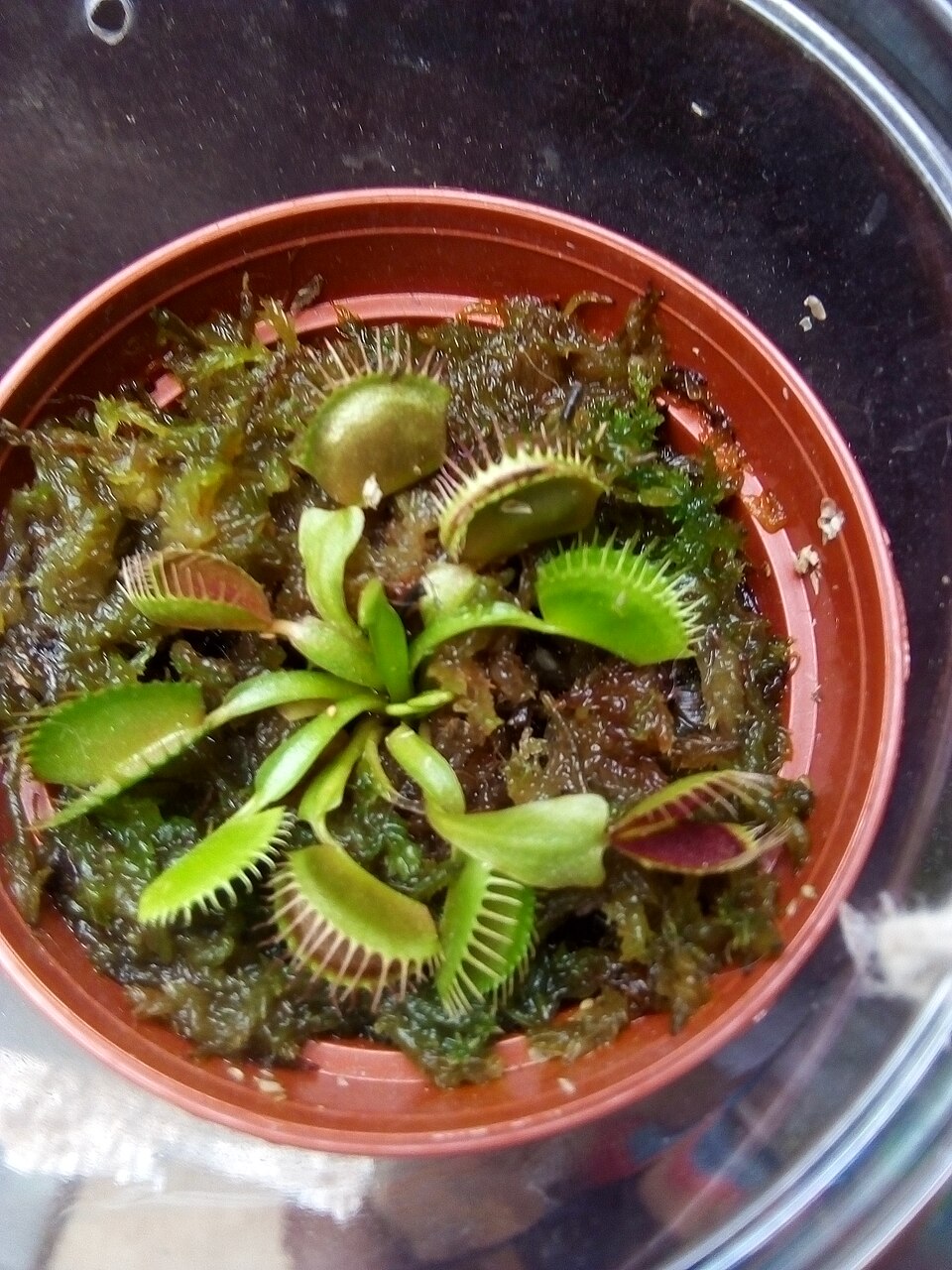
Open traps of a cultivated, potted Venus flytrap. Green and red inner surfaces and marginal projections are visible; this is not a scene of prey being digested.
Photo credit: Fishierd
License: CC BY-SA 4.0
A reduced-size JPEG supplied by Wikimedia is used, with no additional cropping or color changes.
Names and classification
Dionaea muscipula belongs to Droseraceae and is native to a small area in eastern North and South Carolina in the United States. Cultivated or introduced plants elsewhere should not be equated with wild populations in its native range.
Observable features
Leaves cluster near the ground, each with two hinged lobes, marginal projections and sensitive hairs on the inside. White flowers form on a tall stalk separate from the traps, so the flowers should not be described as prey traps.
Distribution and habitat
In its native range it occupies wet, nutrient-poor soils in wetlands and open pine habitats. Increasing shade from encroaching shrubs and trees, or development, can alter those habitat conditions.
Ecology and life cycle
Repeated stimulation of sensory hairs within a short interval closes the trap, and digestion follows when prey is caught. Nutrients from prey do not remove the need for light for photosynthesis; not every leaf is always red or holding prey.
Cultivation and care
Provide ample light and an acidic, nutrient-poor growing environment, prevent the substrate from drying out and manage water quality with rainwater or distilled water. Avoid fertilizing as for ordinary houseplants, and consider both water and substrate properties.
Observation and use precautions
Observe natural movements rather than repeatedly touching traps just to make them close. Choose plants with verified propagation sources instead of wild-collected specimens, and do not remove plants or soil from natural habitats.