
Amphibians
Boreal digging frog
Boreal digging frog
Classification and scientific name: Kaloula borealis
Sources checked:
A voice from underground in the rainy season
During the summer rains in Korea, this frog is easier to hear near wetlands. It starts life in water but spends much of its adult life underground.
Origins and distribution
Grassland and scrub near wetlands in Korea and China
- Breeding calls
- Wetland margins
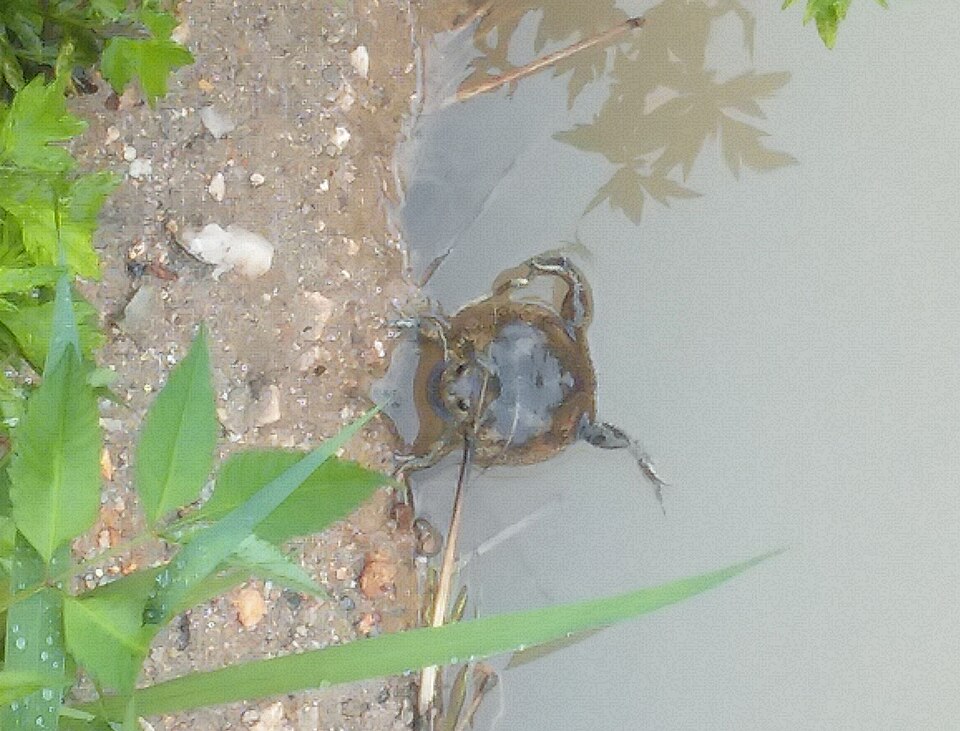
Reference photograph
A rounded frog seen from above, legs spread in cloudy water beside a grassy bank Shown at a reduced size supplied by Wikimedia.
Source: Bongsun · Original material: 맹꽁이7월.jpg · CC BY-SA 4.0
1. A broad body and a small head
About 3.5–5.5 cm long, the frog has a broad body and a short, blunt head. Small spots scatter across its dark brown back, with rounded bumps on the back and nape. Females tend to be a little larger, but length alone does not reliably separate the sexes. The male’s vocal sac becomes dark and hangs below the jaw in the breeding season. The underside is translucent grey, and females lack the male’s throat sac.
2. Hunting on land at night
It usually shelters underground during the day and emerges at night to forage. On land it takes ants and beetles as well as spiders. In Korea the active period generally runs from April to October. It extends beyond the breeding season and ends in winter dormancy. Ground beetles and fruit flies are among the recorded prey, illustrating the variety of food this burrower takes above ground at night.
3. Breeding with the summer rains
In Korea breeding generally falls in the June–August rainy season. The male has a single vocal sac under the chin. To Korean ears the calls sound like “maeng” or “kkong”, echoed in the Korean name. Eggs laid in water hatch in about a day. Korea’s National Institute of Ecology reports about 2,000 eggs in a laying. A day is the time to hatching as a tadpole. Development into a young frog comes later.
4. Habitat beyond the water
Grassland and scrub at wetland edges provide terrestrial habitat for adults. When roads or housing replace pools and the surrounding ground, the frogs lose both breeding water and adult habitat. On Jeju the species occurs from coastal lowlands to volcanic hills and nearby pastures. A map of pools alone misses much of the ground used by adults.
Evidence and references
- National Institute of Ecology species account
Appearance, breeding season and habitats
- Boreal digging frog in the institute’s ecology calendar
Daytime shelter and nocturnal feeding