
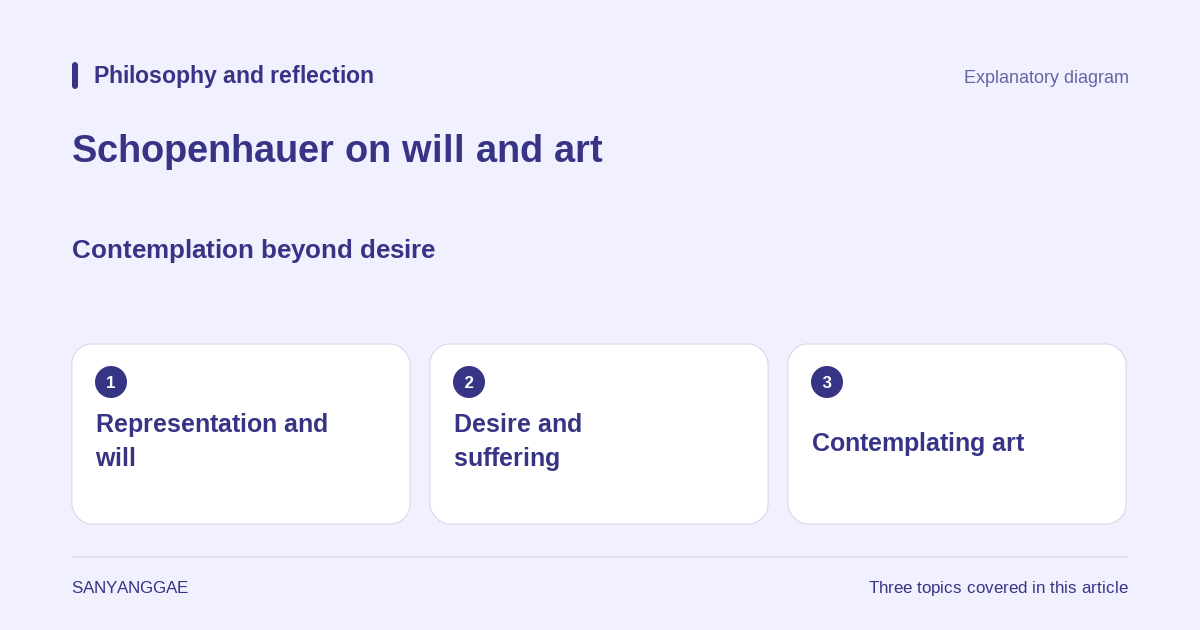
Schopenhauer’s will does not mean resolve or willpower in the everyday sense. His philosophy connects representation, the way the world appears to us, with the perspective of will, through which he explains desire and striving.
1. The problem of desire and satisfaction
In his account, satisfying a desire can lead to new desires and boredom. This is a philosophical view of life and has not been established as a clinical law by measuring everyone’s mental state. Readers can distinguish how the account aims to explain human experience from whether they agree with it.
2. How attention shifts in aesthetic experience
When contemplating art or nature, we can experience an object without focusing exclusively on its usefulness to our desires. This does not amount to saying that watching a favorite video treats stress. Schopenhauer’s account of the cognitive significance of contemplation differs from an everyday change of mood.
3. Music’s special place
Schopenhauer gives music a different status from the other arts. He does not present experimental results showing that particular genres or frequencies are therapeutic. It can be worthwhile to ask how your desires and judgments enter into your experience of a work, while recognizing that his philosophy did not demonstrate the effects of such an exercise.
4. Reading representation and will as two perspectives on an object
Representation means more than a spurious image that comes to mind. It describes a relationship in which an object appears to a knowing subject. Space, time and causality, as experienced when encountering a desk or a tree, form part of the background to this account. Will is not another visible thing standing opposite representation. It is a metaphysical concept that seeks to explain what underlies the world from the perspective of our experience of the body and of desire.
Whether to accept that account is a separate question. People may experience their body and desires differently when they want something, but how that experience could yield a conclusion about the ground of the world as a whole is a matter of philosophical argument. A summary like “I felt desire, so I proved the nature of the universe experimentally” erases the gap between experience and interpretation. First establish what the system claims, then ask whether its reasoning is persuasive.
Mistaking will for strong personal resolve also changes how we understand his explanation of art. Temporarily stepping outside the will does not mean losing willpower or giving up everyday responsibilities. One way to read it is that our relation to the object is no longer bound solely to what we immediately need or wish to possess. The first task is to avoid projecting the everyday meaning onto the philosophical term.
5. Looking twice at the same painting in a gallery
Consider a fictional example to help interpret the idea. Someone sees a painting in a gallery and thinks first about its price and value as an investment. The painting is something to assess for a possible sale. A moment later, this person sets aside ownership and appraisal and attends to the relations among colors, recurring forms and the composition. The object is the same, while the direction of attention changes. This difference offers a way into Schopenhauer’s distinction between a desire-centered relation and contemplation.
Still, not every moment spent without thinking about price amounts to pure contemplation in his philosophy. The viewer might want to look knowledgeable to others or to understand the wall text quickly. Real appreciation mixes different motives. An example that explains a concept is different from a test of someone’s inner state, so there is no reason to judge other visitors as insufficiently contemplative.
The idea that contemplation is unconcerned with practical use does not mean taking no interest in the work. It can involve close attention to its form and character. Describing what you saw in your own words afterward can reveal how much of your account is taken up by price, reputation or personal memories. This exercise was devised for today’s readers. It is neither a research finding about the effects of art appreciation nor a treatment proposed by Schopenhauer.
With music, we can ask how relationships among sounds become meaningful without depicting particular objects as a painting might. Schopenhauer gives music a special relationship to will, but turning that into the claim that someone’s favorite genre reveals their essential character would change the basis of the claim. Feeling tension and release in a melody is also different from concluding that his metaphysics is true. One intense experience does not prove an entire system.
6. Considering aesthetic insights alongside the limits of the system
Looking at art as more than a means to compete and achieve raises questions for readers today. If you focus entirely on taking a good photo at a performance or on the number of works you have seen, you may miss what you actually experienced. Keeping records and learning are still worthwhile activities. Contemplation can prompt questions about where your attention goes without serving as a single scale for ranking activities.
Schopenhauer’s hierarchy of the arts and his theory of genius also deserve critical reading. Identify why the system gives some arts higher standing and ask whether it adequately explains today’s range of artistic practices and experiences. You can discuss the relationship between desire and appreciation without accepting music’s special status. Accepting an insight from part of a system and endorsing its whole metaphysics are separate decisions.
In your reading notes, separate concepts, locations in the text and examples of your own. As you read Book III of the first volume of *The World as Will and Representation*, where the discussion of aesthetics is concentrated, mark claims about knowledge and claims about the value of art. Use the notes to check translated terms such as will, representation and Idea against their ordinary meanings. Do not assume the same term automatically means the same thing in another philosopher.
Turning the practical conclusion into “let’s want nothing” can erase goals and responsibilities to others. Here, the exercise concerns where attention goes at one moment of encountering art. What benefit do I immediately seek from the object, and what might become visible if I suspend that judgment for a moment? You can connect the point about aesthetics to everyday experience without treating a changed answer as a guarantee of escape from all suffering.
You can also compare your descriptions after viewing art. If at first you only noted that the work was famous, but later described the brightness of the composition or the relationships in the melody in detail, you may have noticed a shift in attention. A more detailed description does not establish that you attained pure contemplation. Keep the exercise as a chance to ask what you saw and what you desired, without turning it into another grading scheme.