
Korean pine
The needles of the Korean pine grow in bundles of five. Viewed from the side, a young cone shows how the tips of its scales project outwards.
- Scientific name
- Pinus koraiensis Siebold & Zucc.
- Family
- Pine family · Pinaceae
- Other names
- Strobus koraiensis
- Reviewed
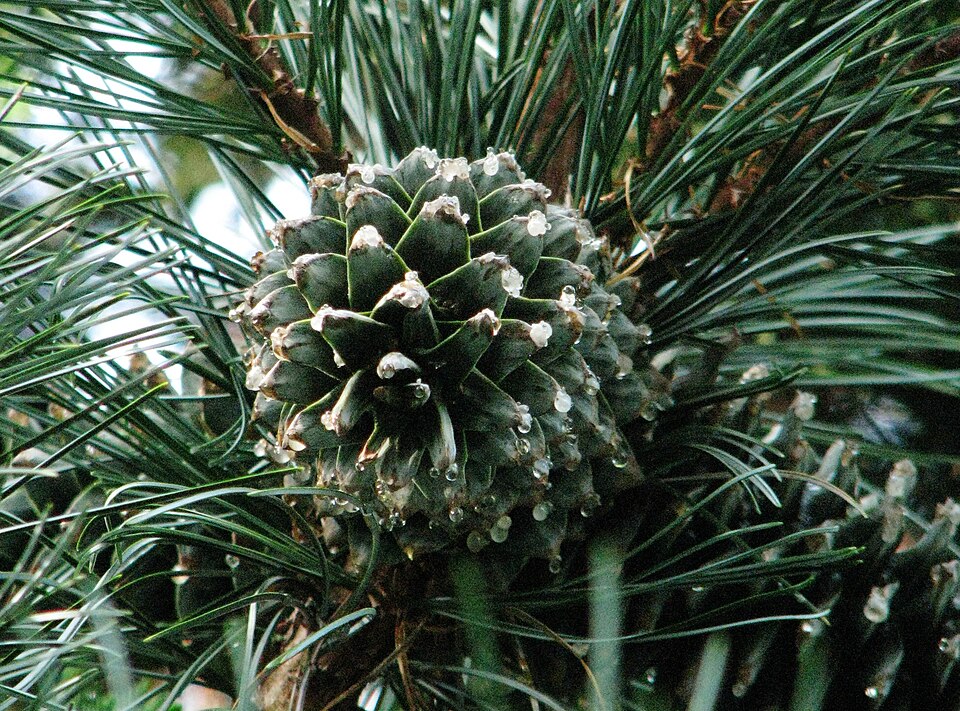
This tree was grown at the University of Wrocław Botanical Garden in Poland. Pale droplets are visible at the tips of the young cone’s scales.
Pinus koraiensis Sosna koreańska 2011-09-11 02.jpg
Photo credit: Agnieszka Kwiecień, Nova
License: CC BY-SA 4.0
Wikimedia’s 960-pixel-wide JPEG thumbnail is reproduced unchanged.
Names and classification
The Korean pine is an evergreen conifer in the pine family. The pine nuts it produces are seeds that develop on the cone scales.
Observable features
Follow the needles back to their base. A Korean pine usually has five per bundle, while a Japanese red pine (Pinus densiflora) has two. Pale lines mark the inner faces of Korean pine needles.
Count the needles in one bundle. Japanese red pine has two and Korean pine has five.
Distribution and habitat
Its native range includes the Korean Peninsula, northeastern China, the Russian Far East and Japan. On the peninsula it grows in cool mountain areas and is also planted for its seeds.
Ecology and life cycle
The same tree bears pollen cones and seed cones. The wingless seeds ripen in autumn of the following year.
Cultivation and care
Choose a sunny site with good drainage. Before planting a sapling, allow room for the spreading branches of the mature tree.
Observation and use precautions
Several other pines also have five needles in a bundle. Record the shape of the cones as well as the needle count when identifying a tree.